

Key Takeaways
- A working feline spacer needs four things DIY can't provide: a one-way inhalation valve, an anti-static coating, the correct chamber volume, and a flow indicator — miss any one and medication delivery drops sharply.
- Toilet paper rolls, plastic bottles, and storage bins are training tools at best — fine for desensitizing a cat to the mask feel, but useless for actually delivering fluticasone to the lungs.
- A DIY chamber typically wastes more money than it saves: one wasted Flovent puff costs roughly $2.50, and cats on daily inhaled steroids waste 100+ puffs in a month of poor-seal DIY use.
- Trudell Animal Health states directly that human and improvised spacers don't fit cats' faces, leading to "medication waste and ineffective treatment" — the manufacturer's own words.
- A purpose-built veterinary chamber costs under $35; if cost is the barrier, the fix is a cheaper chamber, not a homemade one.
Your cat was just diagnosed with asthma. The vet handed you a prescription for fluticasone. Then you looked up the AeroKat price tag — $80 to $100 — and a quick search returned videos of people taping inhalers to plastic bottles. The math looks tempting. The reality isn't.
Here's the physics of why homemade cat inhaler chambers fail, which DIY approaches kind of work, and the cheaper alternative that doesn't compromise your cat's treatment.
Why DIY Sounds Tempting (and Where It Falls Apart)
The appeal is obvious. AeroKat chambers run $80+. Generic veterinary chambers are $40-60. A plastic bottle is free. A toilet paper roll is already in your bathroom. And you've seen a Facebook post where someone's aunt used a baby spacer on her cat "just fine."
But a feline aerosol chamber isn't just a tube with a hole. It's a precision medical device doing four jobs at once, and missing any one of them turns a $200 Flovent inhaler into an expensive way to coat the inside of a bottle with medication.
The Four Things a Real Chamber Does That DIY Can't
1. One-Way Inhalation Valve
Cats breathe shallowly — about 25-30 breaths per minute, with small tidal volume. A real chamber has a sensitive one-way valve that opens on inhale and seals on exhale, so exhaled air (and medication) doesn't flow back into the chamber and out the mask. A bottle with a hole has no valve. Every exhale pushes medication back out, and the next inhale pulls in air from the room, not the medication-rich chamber air.
2. Anti-Static Coating
Fluticasone particles are tiny — around 2-4 microns. Static electricity on plastic surfaces grabs those particles before they ever reach your cat's lungs. Commercial chambers use anti-static materials (like the AeroKat's polymer blend) specifically to prevent this. A cut-up soda bottle is highly static-prone. Up to 40% of the medication can stick to the wall instead of being inhaled.
3. Correct Chamber Volume
The chamber holds the medication puff long enough for the cat to inhale it in 5-7 small breaths. Too big, and the medication disperses into dead space the cat never reaches. Too small, and the puff doesn't have room to slow down — particles slam into the back of the chamber or the cat's throat instead of settling into the lungs. AeroKat's volume (~155 mL) is tuned for feline tidal volume. A 2-liter bottle is 13× too big.
4. Flow Indicator
Without a Flow-Vu indicator or equivalent, you have no way to know if your cat actually inhaled the dose. You're guessing. With asthma medication costing $200+ per inhaler, guessing gets expensive fast — and worse, your cat's symptoms keep progressing because the medication never reaches the lungs.
The Four DIY Approaches, Ranked
Plastic Bottle Chamber (Verdict: Do Not Use)
Cut the bottom off a water bottle, poke a hole for the inhaler, tape on a mask. Sounds elegant. In practice: no valve, wrong volume, static cling, and a mask seal that never quite works. This is the approach that wastes the most medication while looking the most functional.
Toilet Paper Roll (Verdict: Training Tool Only)
A Reddit user in r/CatTraining popularized holding a clean toilet paper roll against a cat's face to get them used to the sensation before introducing a real chamber. This is genuinely useful for desensitization training — but it delivers zero medication. Use it to train, never to treat.

Baby Spacer Repurposed (Verdict: Better Than Bottle, Still Suboptimal)
In regions where AeroKat isn't sold (parts of Australia, rural areas), owners use infant spacers like the AeroChamber Plus Baby with a small mask. These have a valve and anti-static coating, so they're closer to functional. But infant tidal volume is much larger than a cat's, the mask doesn't seal a cat's muzzle shape, and you're still flying blind without a flow indicator. Acceptable as a 24-hour bridge, not a long-term solution.
Sterilite Bin Nebulizer Tent (Verdict: Different Tool, Different Job)
A storage bin with a hole cut for the inhaler puffer, placed over the cat as a mini-nebulizer tent. This actually delivers some medication — but as one r/CATHELP owner put it after building one: "It's nowhere near as effective as a spacer inhaler." The dose is uncontrolled, the cat gets startled, and it's for crisis moments when no chamber exists at all.
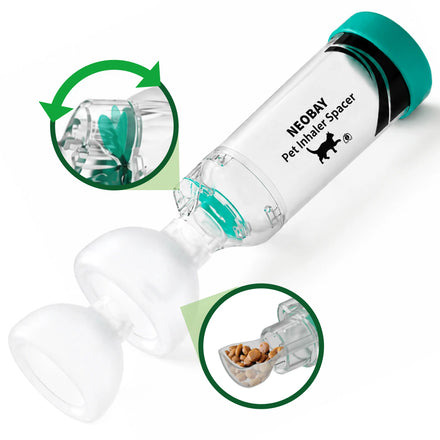
Neobay Cat Aerosol Chamber with Comfort Feeder — Green
- See each breath with the Breath Indicator
- Built-in treat holder makes mask practice easier
- Anti-static chamber helps keep medication airborne
When DIY Is Actually OK
There's one legitimate use of household items: desensitization training before treatment starts. If your cat has never seen a mask, hold a clean toilet paper roll or a small plastic cup against their muzzle for 2-3 seconds, treat, repeat. This gets them used to the sensation so when the real chamber arrives, you skip the 7-day fight.
This is the only DIY that helps. It does not deliver medication. The moment you have a prescription in hand, you need a real chamber.
The Real Cost Math
Here's the part most DIY guides skip. The chamber is cheap. The medication isn't.
- Flovent 110 mcg (120 puffs): ~$200-280 retail in the US, ~$120 from Canadian pharmacies
- Cost per puff: $1.65-2.35
- Typical cat dose: 2 puffs × 2x daily = 4 puffs/day = ~120 puffs/month
- DIY chamber waste rate: conservatively 50% of medication lost (no valve, static, poor seal)
- Monthly cost of lost medication: ~$100-140 wasted
A Neobay Aerosol Chamber costs less than $35 — less than one month of wasted Flovent. The "savings" from DIY evaporate in the first week, and your cat's symptoms don't improve because the medication never reaches the lungs. For more on what makes a chamber effective, see our 3-way spacer comparison.

What If You Can't Afford a Chamber Right Now?
If cost is genuinely the blocker, here's the priority order:
- Call your vet — many clinics stock loaner chambers or have manufacturer samples
- Ask about generic veterinary chambers — under $35 is achievable without DIY
- Order fluticasone from a regulated Canadian pharmacy with a US prescription (saves 50-60% on the medication itself, see our affordability guide)
- Use the wait time for toilet-paper-roll desensitization training — so you're ready the day the chamber arrives
Never substitute a homemade chamber for actual treatment. Asthma in cats worsens silently between attacks, and undertreatment leads to airway remodeling that becomes permanent.
Frequently Asked Questions
Can I use a toilet paper roll as a cat inhaler spacer?
Only for desensitization training — getting your cat used to the feeling of something against their muzzle. A toilet paper roll has no valve, no chamber volume, and no flow indicator, so it delivers essentially zero medication to the lungs.
Is a baby spacer safe to use on a cat?
Better than a plastic bottle, but still suboptimal. Baby spacers have a one-way valve and anti-static coating, but their mask doesn't seal a cat's muzzle shape and the chamber volume is tuned for human infant lungs, not feline airways. Use as a short-term bridge only if no veterinary chamber is available.
Why can't I just use a plastic bottle with a hole for the inhaler?
Three reasons: no one-way valve means exhaled medication escapes, plastic bottle walls are highly static-prone and trap up to 40% of the dose, and the volume is far too large for a cat's small breath. The medication mostly coats the bottle instead of reaching your cat's lungs.
How much medication does a DIY chamber waste?
Conservatively, 50% or more. With Flovent at roughly $2 per puff and a typical cat needing 4 puffs per day, that's $100-140 in wasted medication every month — more than the cost of a proper veterinary chamber.
What's the cheapest safe cat inhaler spacer?
Generic veterinary aerosol chambers with a one-way valve and flow indicator start around $30-35. That's less than one month of wasted Flovent through a DIY chamber, and it actually delivers the medication your cat needs.
What to Do Next
- If your cat is newly diagnosed, start toilet-paper-roll desensitization training today while you source a real chamber.
- If cost is the issue, call your vet about loaner chambers or samples, and check generic veterinary options under $35.
- When you're ready to buy, see the Neobay Aerosol Chamber — it has all four critical features (valve, anti-static coating, correct volume, flow indicator) at roughly one-third the AeroKat price.
Have questions about your cat's specific situation? Visit our FAQ page or contact us directly — we read every message.
Sources
- Trudell Animal Health. "How to use a cat inhaler to treat feline asthma." Trudell Animal Health Blog, 2024.
- Cornell Feline Health Center. "Feline Asthma: What You Need to Know." Cornell University College of Veterinary Medicine. https://www.vet.cornell.edu/departments-centers-and-institutes/cornell-feline-health-center/health-information/feline-health-topics/feline-asthma-what-you-need-know
Related Reading
This article is part of our What Is a Cat Inhaler Spacer? — covering device types, how to use them, proper technique, cleaning, and troubleshooting.


