

Key Takeaways
- Technically, a baby spacer (Babyhaler or AeroChamber) can deliver medication to a cat — but it is not designed for feline breathing patterns, and most veterinarians do not recommend it as a long-term solution.
- The volume mismatch is the biggest problem: baby spacers hold 145-175 ml of air, while a cat's tidal breath is only 5-25 ml — meaning most of the medication stays trapped in the chamber instead of reaching the lungs.
- Baby mask geometry (round, wide, rigid) does not seal against a cat's pointed face, so up to 30-50% of each puff can leak out through gaps around the nose and eyes.
- Baby spacer valves are calibrated for infant inhalation strength; some cats cannot generate enough suction to open them, which means zero medication is delivered even when the mask is on the face.
- If you have zero other option tonight, a baby spacer will deliver some medication — but ordering a proper feline chamber for delivery next week is the right move for any cat on long-term inhaled treatment.
Your cat was just diagnosed with asthma. The vet wrote you a prescription for fluticasone. You picked up the inhaler at the pharmacy. Then the vet said you need something called a "spacer chamber" — and the one she recommended costs $80, takes a week to ship, and your cat is coughing right now.
So you Google "can I use my baby's spacer for my cat" and the results are confusing. Some forum posts say yes, it works fine. Others say absolutely not. Your medicine cabinet has a Babyhaler or an AeroChamber from when your kid had RSV last winter. It looks the same. It feels the same. Can you just... use it?
Here's the honest answer: yes, technically, you can — and it will deliver some medication. But it is not designed for a cat, the dose your cat actually receives will be much lower than what the vet prescribed, and you may not realize the difference until the asthma gets worse. This guide explains exactly what baby spacers are, why they don't quite work for cats, when using one is acceptable, and when it's a genuinely bad idea.
What Babyhaler and AeroChamber Actually Are
Babyhaler and AeroChamber are both spacer chambers designed for human infants and small children. They attach to a standard metered-dose inhaler (MDI), capture the medication cloud, and let the child breathe it in over several breaths instead of trying to coordinate a single sharp inhale.
Babyhaler is made by GSK and is designed for infants and toddlers up to about 5 years old. It has a soft, clear silicone mask and a 350 ml chamber. It's been around since the 1990s and is widely used in the UK, Canada, and parts of Europe.
AeroChamber is made by Monaghan Medical and comes in several sizes — the infant and pediatric versions are most relevant to this discussion. The AeroChamber Mini (for infants) has a 75 ml chamber; the standard pediatric AeroChamber has a 145 ml chamber. The masks are smaller than Babyhaler's and slightly softer.
Both devices are excellent for what they're designed to do: deliver inhaled medication to a small human who can't time their breath to the inhaler actuation. The question is whether "small human" translates to "cat."
It doesn't. Not cleanly.
The Three Critical Mismatches
Three things make a baby spacer a poor fit for a cat — even though all three look identical to the untrained eye.
1. Chamber Volume vs. Tidal Breath
This is the biggest problem, and it's invisible until you do the math.
A typical human infant has a tidal breath (the volume of one normal in-and-out breath) of about 60-100 ml. A human adult's tidal breath is 400-500 ml. That's why baby spacers are designed with chamber volumes in the 75-350 ml range — there has to be enough room for the full medication cloud to expand, and the child breathes it in over 4-5 tidal breaths.
A cat's tidal breath is roughly 5-25 ml — depending on size. A 10 lb adult cat moves about 10-15 ml of air per breath. That's an order of magnitude smaller than an infant.
Here's what that means in practice: when you puff medication into a 145 ml AeroChamber and your cat takes a 10 ml breath, your cat gets 10/145 = about 7% of the available medication. To get the full dose, your cat would need to take roughly 14 perfectly sealed breaths through the chamber before the medication settled out or leaked. The "7-10 breaths" rule that works for AeroKat (a 145 ml chamber designed with the Flow-Vu indicator to confirm delivery) does not work the same way for a baby spacer on a cat.
Worse, medication particles in a baby spacer are calibrated to stay aerosolized for about 30-60 seconds before settling onto the chamber walls. After that, they're stuck. If your cat takes small, slow breaths over 30 seconds, most of the medication is already gone.
2. Mask Geometry
Human infant faces are round and flat. Cat faces are pointed and elongated. The masks that come with Babyhaler and AeroChamber are circular — typically 50-65 mm in diameter — and designed to seal against a relatively flat surface.
A cat's face doesn't present a flat surface. The nose sticks out. The whisker pads bulge. The eyes are large and prominent. When you press a round baby mask against a cat's face, you typically get one of three outcomes:
- The mask covers the nose but leaks at the corners of the mouth
- The mask presses against the eyes (which the cat will not tolerate)
- The mask is angled to seal against the nose, leaving a gap at the top where medication escapes
The "soft" silicone on baby masks compounds the problem. Soft silicone conforms well to a flat surface but folds and buckles against a contoured one. Feline-specific chambers like AeroKat and Neobay use stiffer silicone that holds its shape against the cat's facial contours.
3. Valve Sensitivity
Both Babyhaler and AeroChamber have one-way valves that open when the patient inhales and close when they exhale. These valves are calibrated for an infant's inhalation strength.
Cats breathe differently than infants. They take shorter, shallower, faster breaths. Some cats — especially senior cats, cats with severe asthma, and cats that are frightened by the mask — don't generate enough negative pressure to consistently open a baby spacer valve. When the valve doesn't open, no medication is delivered. You'll see the mask fog up briefly, but your cat is rebreathing her own exhaled air with zero drug in it.
The AeroKat's valve is specifically designed to open at lower inspiratory flows (around 15-20 L/min) compared to baby spacer valves (often 30+ L/min). This is the single biggest engineering difference between a real feline spacer and a repurposed baby spacer.
When a Baby Spacer Is Acceptable
Despite all those caveats, there are real situations where using a baby spacer makes sense for a cat:
- The first night after diagnosis, when your cat needs medication immediately and the AeroKat is still 5-7 days away in shipping
- Acute respiratory distress at 2 a.m., when no veterinary ER is open and you have a rescue inhaler (albuterol) but no cat chamber
- Severe financial constraint — a $10 baby spacer from a thrift store or hand-me-down is better than no medication at all
- Short-term bridging while a feline-specific chamber is being ordered
In each of these cases, the goal is "deliver some medication, even if it's a fraction of the prescribed dose." That fraction can still help — particularly for albuterol, which is a fast-acting bronchodilator that works even at reduced dose.
If you fall into one of these categories, read the "how to make it work" section further down.

When a Baby Spacer Is a Bad Idea
Some cats should not use a baby spacer at all, even short-term:
- Cats on long-term controller medication (fluticasone) — the cumulative dose shortfall over months leads to poor asthma control and worsening symptoms
- Cats with severe or poorly controlled asthma — they need every microgram of prescribed medication; a 30-50% reduction can trigger attacks
- Kittens under 4 weeks old — their tidal breath is so small that even an infant spacer delivers almost nothing
- Cats that already hate the mask — using a poorly-fitting baby mask can teach the cat that the mask = stress and leakage, making future training on a proper chamber harder
- Cats with brachycephalic (flat-face) anatomy — Persians, Himalayans, and Exotic Shorthairs have the worst mask seal of any cat, and baby masks are wider and rounder than cat-specific masks, which makes the leak even worse
For a deeper dive on flat-face cats and mask fit, see our guide to AeroKat mask sizing for small, senior, and flat-face cats.
The Flow Indicator Problem
One feature separates a real feline chamber from a baby spacer more than any other: the flow indicator.
AeroKat calls theirs the "Flow-Vu." It's a small colored flap that moves when the cat inhales and stops when she exhales. You can see — in real time — whether your cat is actually drawing air through the chamber. No flap movement means no medication delivery.
Babyhaler and most AeroChamber models do not have this feature. You have no way to know whether:
- The valve is opening
- The mask is sealing
- The cat is taking productive breaths
- The medication has settled out of the air column
You puff. You wait 10 seconds. You remove the mask. Did it work? You have no idea. Maybe yes. Maybe the cat was panicking the whole time and rebreathing CO2 with no drug in the loop. Maybe 80% of the dose leaked out the side of the mask. You can't tell.
This is the single biggest reason veterinarians recommend a feline-specific chamber. The cost difference is $30-60. The information difference is enormous.
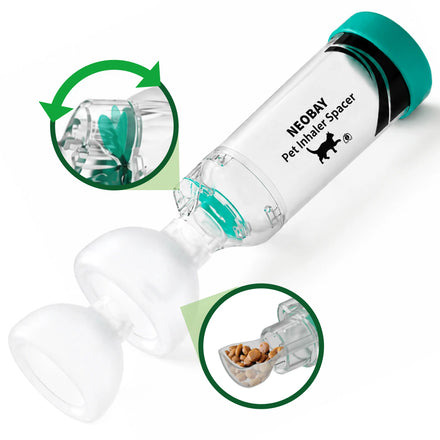
Neobay Cat Aerosol Chamber with Comfort Feeder — Green
- See each breath with the Breath Indicator
- Built-in treat holder makes mask practice easier
- Anti-static chamber helps keep medication airborne

How to Make a Baby Spacer Work If You Must
If you're in one of the "acceptable" categories above — first-night emergency, financial bridge, etc. — here's how to maximize what a baby spacer can do for your cat.
Step 1: Use the smallest mask that fits. If your AeroChamber came with both infant and pediatric masks, use the infant mask. The smaller diameter gives you a better chance of a seal against the cat's face.
Step 2: Position the mask over the nose and the front of the mouth — not the whole face. Aim for the area from the bridge of the nose to just below the lower lip. Trying to cover the whole face is what causes eye pressing and leakage.
Step 3: Use the "tent" technique — press gently down so the mask deforms slightly against the face, then hold for 12-15 breaths (not 7-10 — give the cat more chances to inhale from a chamber that wasn't designed for her).
Step 4: Watch the cat's chest, not the mask. Since you don't have a flow indicator, watch for visible chest rise. Each visible rise = one productive breath. Aim for 10-12 visible chest rises before removing the mask.
Step 5: Don't shake or reposition the chamber mid-puff. The medication cloud in a baby chamber settles fast. Once you actuate the inhaler, hold still.
Step 6: Actuate directly into the chamber, then apply the mask immediately — within 1-2 seconds. The longer the gap between the puff and the mask on the face, the more medication settles in the chamber before the cat can breathe it.
Step 7: Order a real feline chamber today. Even a perfect baby spacer technique delivers maybe 50-70% of prescribed medication. A cat-specific chamber delivers 90%+. Over a year, that difference is the difference between controlled asthma and emergency vet visits.
What Real Owners Report
On Reddit's r/CatAdvice and the feline asthma groups on groups.io, owners who have tried baby spacers as a stopgap describe a consistent pattern:
- The first puff or two seems to work — the cat settles down, breathing calms
- After a few weeks, symptoms creep back — nighttime coughing, decreased energy, more albuterol use
- When they finally switch to a proper AeroKat or Neobay chamber, the cat improves noticeably within a week
The pattern matches what we'd predict from the physics: the baby spacer delivers enough medication to look like it's working short-term, but the steady shortfall catches up with the cat over weeks to months. Owners who used baby spacers long-term almost universally report better outcomes after switching.
The Cost Comparison
One of the main reasons owners reach for a baby spacer is cost. Here's the actual cost picture:
| Option | Upfront Cost | Effective Cost Over 1 Year |
|---|---|---|
| Babyhaler (used/hand-me-down) | $0-15 | $0-15 + wasted medication + likely vet bills from poor control |
| AeroChamber Mini (new) | $25-40 | $25-40 + same issues as Babyhaler |
| AeroKat (Trudell) | $80-100 | $80-100, no wasted medication |
| Neobay Cat Aerosol Chamber | $40-60 | $40-60, no wasted medication, comfort-feeder mask design |
When you factor in the cost of wasted fluticasone (at $50-100 per inhaler, every wasted puff adds up fast) and the cost of emergency vet visits from uncontrolled asthma, the "cheap" baby spacer option becomes the most expensive option within months.
For a side-by-side breakdown of the feline-specific options, see our comparison of AeroKat and Neobay chambers.
Frequently Asked Questions
Can I use a baby spacer for my cat's asthma medication?
Technically yes, but it's not recommended as a long-term solution. Baby spacers are designed for human infant breathing patterns (60-100 ml tidal breath), while cats move only 5-25 ml per breath. This means a cat receives only a fraction of the prescribed dose from a baby spacer. For emergency use on the first night or as a 1-week bridge while a proper feline chamber ships, it's acceptable. For ongoing daily treatment, get a cat-specific chamber.
Is Babyhaler or AeroChamber better for cats?
Neither is good for cats — both are designed for human infants. If forced to choose, the AeroChamber Mini (75 ml) is slightly better than the Babyhaler (350 ml) because the smaller chamber volume is closer to a cat's tidal breath. But "slightly better" still means most cats get only 30-50% of prescribed medication. A proper feline chamber delivers 90%+.
Why doesn't my cat's baby spacer valve open?
Baby spacer valves are calibrated for infant inhalation strength (about 30+ L/min peak inspiratory flow). Some cats, especially seniors, cats with severe asthma, and frightened cats, can't generate enough suction to open the valve. When the valve doesn't open, zero medication is delivered — even though the mask is on the cat's face. This is one of the biggest engineering differences between baby spacers and feline-specific chambers like AeroKat.
Will using a baby spacer harm my cat?
Not directly — baby spacers are sterile, inert devices that don't expose your cat to anything harmful. The risk is indirect: underdosing over weeks or months leads to poor asthma control, which can trigger severe attacks that require emergency veterinary care. If you must use a baby spacer for a few days while a feline chamber ships, that's fine. If you're tempted to use one long-term because it's cheaper, the math doesn't work — the savings on the device are wiped out by wasted medication and ER bills.
My baby's spacer has a flow indicator. Can I use it for my cat?
Some AeroChamber models include a "Flow-Vu" style indicator. That helps — you can see whether the cat is inhaling. But it doesn't fix the volume mismatch (chamber too big for the cat's tidal breath) or the mask geometry problem (round baby mask doesn't seal a cat's pointed face). The indicator tells you something is happening, but not whether the cat is getting the full dose.
What's the smallest cat I can use a baby spacer on?
For kittens under 8 weeks old, baby spacers are essentially useless — the kitten's tidal breath is too small to draw meaningful medication out of the chamber. For kittens 8-16 weeks, a baby spacer can deliver some medication but should only be used as a bridge to a proper chamber. For adult cats over 6 months, the baby spacer delivers a measurable (but reduced) dose — typically 30-50% of what the cat would get from a feline chamber.
Can I just give my cat the inhaler directly without a spacer?
No. This is more dangerous than using a baby spacer. A metered-dose inhaler fires medication at 60+ mph; pressed directly against a cat's face, the blast can injure the eyes, the cat will panic and pull away, and less than 10% of the medication reaches the lungs. Some form of spacer — even a baby spacer — is dramatically better than no spacer. For more on this, see our guide to what a cat inhaler spacer actually does.
What to Do Next
- If you're using a baby spacer right now as a stopgap, order a feline-specific chamber today. The cost difference is $30-60, and it determines whether your cat gets the full prescribed dose or 30% of it. The longer you wait, the more asthma control slips.
- Audit your cat's current symptom control. If you've been using a baby spacer for more than a month and your cat still has coughing, wheezing, or nighttime breathing changes, the spacer is likely the bottleneck — not the medication, not the dose.
- Talk to your vet about a training plan. If your cat has learned to hate the mask from poorly-fitted baby spacer sessions, you may need to retrain from scratch with a chamber designed for positive reinforcement (food-led, low-stress).
- If cost is the barrier, see our guide to affording cat asthma treatment — there are multiple assistance programs and cheaper feline chamber options that beat the "free" baby spacer over a full year.
A baby spacer is better than no spacer. A feline-specific chamber is better than a baby spacer. The cost difference is small. The dose difference is huge. The choice is yours.
Have questions about using a baby spacer with your cat or transitioning to a proper chamber? Visit our FAQ page or contact us directly.
Sources:
- Padrid P. "Use of inhaled medications to treat respiratory diseases in dogs and cats." Journal of the American Animal Hospital Association, 2006; 42(2): 165-169.
- Barchilon M, Reinero CR. "Breathe easy: inhalational therapy for feline inflammatory airway disease." *Journal of Feline Medicine and Surgery*, 2023; 25(9).
- Cornell Feline Health Center. "Feline Asthma: What You Need to Know." Cornell University College of Veterinary Medicine. https://www.vet.cornell.edu/departments-centers-and-institutes/cornell-feline-health-center/health-information/feline-health-topics/feline-asthma-what-you-need-know
- Trudell Medical International. "AeroKat Chamber Design and Tidal Volume Specifications for Feline Patients."
- Monaghan Medical Corporation. "AeroChamber Product Specifications: Infant and Pediatric Models."
- GlaxoSmithKline. "Babyhaler Patient Information and Usage Instructions."
- Mazan, M. R., et al. "Determination of the Volume of Aerosolized Medication Delivered to Feline Patients via Various Spacer Devices." *Journal of Veterinary Internal Medicine*.
- r/CatAdvice and Feline Asthma Inhaled Medications Group (groups.io) owner reports on baby spacer use in cats, 2022-2025.
- American Academy of Pediatrics. "Use of Spacer Devices in Pediatric Asthma Management."
- National Asthma Education and Prevention Program. "Expert Panel Report 3: Guidelines for the Diagnosis and Management of Asthma."
Related Reading
This article is part of our What Is a Cat Inhaler Spacer? — covering device types, how to use them, proper technique, cleaning, and troubleshooting.


