

Key Takeaways
- Coughing without producing a hairball is the #1 early sign of feline asthma that owners dismiss — often for months.
- A cat's normal resting breathing rate is 24–30 breaths per minute. Consistently above 30 at rest warrants a vet visit.
- Decreased play stamina in a young or middle-aged cat isn't "just getting older" — it can signal reduced lung capacity from chronic airway inflammation.
- Left unmanaged, feline asthma causes irreversible airway remodeling — scar tissue that permanently narrows the breathing passages.
- Early diagnosis and inhaled medication via a spacer can let most cats live normal, active lives without daily pills.
Your cat crouches low, stretches her neck forward, and makes a hacking sound. You wait for the hairball. Nothing comes up. She does it again three days later. Still nothing.
You tell yourself she's fine — she's eating, playing, acting normal. So you wait.
The signs are there. They're just easy to miss. Here's what to look for — and why catching them early changes everything.
The #1 Sign Owners Miss: Coughing ≠ Hairballs
If you remember one thing from this article, make it this: a cat coughing repeatedly without producing anything is not normal.
Hairballs happen. A cat gags, retches, and eventually brings up a wet tube of fur. That's a hairball. Done.
Feline asthma — chronic inflammation of the lower airways triggered by inhaled allergens — looks different. The cat hunches low, extends the neck forward, and produces a dry, wheezy cough. Nothing comes up. And it happens again.
Here's the difference:
| Asthma Cough | Hairball |
|---|---|
| Dry, wheezy sound | Wet, guttural retching |
| Neck extended forward, body low | Hunched, abdominal heaving |
| Nothing produced | Eventually produces fur tube |
| Happens repeatedly over days/weeks | Occasional, resolves after expulsion |
| Often triggered by exercise or allergens | No clear trigger pattern |

One Reddit owner summed it up: "I gave her hairball gel for six months before a vet said, 'That's not hairballs. That's asthma.' I felt terrible." On feline asthma forums, delayed diagnosis by 2–12 months is the norm, not the exception.
If your cat is coughing more than once a week — especially without producing anything — film it on your phone and show your vet. A video is worth more than any verbal description.
5 Subtle Signs That Don't Look Like Asthma
Not every cat coughs. Some show asthma through signs so subtle owners don't connect them to breathing at all.
1. Your Cat Tires Out Faster Than Before
A two-year-old cat who used to chase the wand toy for 10 minutes now stops after two. Easy to dismiss as "getting lazy" or "just being a cat." But reduced stamina can be the first outward sign of reduced lung capacity. The airways are narrowing — not enough to cause audible wheezing yet, but enough that exertion leaves her winded sooner.
2. Resting Breaths Per Minute Above 30
A healthy cat at rest takes 24 to 30 breaths per minute. Count while your cat is sleeping: watch the chest rise and fall, count for 15 seconds, multiply by four. If you consistently get numbers in the mid-30s or higher, something is making the lungs work harder than they should. This single at-home check catches respiratory issues before they become visible emergencies.
3. Occasional Wheezing You Only Hear at Night
When the house is quiet, you might hear a soft whistle at the end of an exhale. It comes and goes. You second-guess yourself — "did I actually hear that?" Mild intermittent wheezing, especially at night, is a classic early asthma sign. Airways narrow more during sleep, making subtle sounds audible that wouldn't be noticeable during the day.
4. The "Asthma Posture" Without the Cough
A cat in respiratory distress assumes a specific posture: crouched low, neck extended forward and slightly down, elbows rotated outward. It's an instinctive attempt to open the airways. Owners often mistake it for a stretch. The difference: a stretch lasts seconds. The asthma posture may hold for a minute or more, and it repeats.

5. Restlessness During Sleep
A cat who can't settle — shifting positions, getting up and lying back down — may be uncomfortable because of labored breathing, not the bed. If this pairs with any of the signs above, pay attention.
Why Early Detection Matters (It's Not Just About Comfort)
There's a medical reason to catch feline asthma early that goes beyond symptom relief. It's called airway remodeling.
Every asthma flare deposits tiny amounts of scar tissue in the airway walls. Over months and years, the walls thicken. The airways become permanently narrower. At that point, even with medication, the damage is structural. Studies in the Journal of Feline Medicine and Surgery show that cats diagnosed late show significantly more irreversible changes on radiographs than cats treated early.
The practical difference: a cat diagnosed early often needs only a low-dose inhaled steroid. A cat diagnosed late may need multiple medications and still have reduced quality of life. Same disease — wildly different outcome, determined by when someone connected the dots.
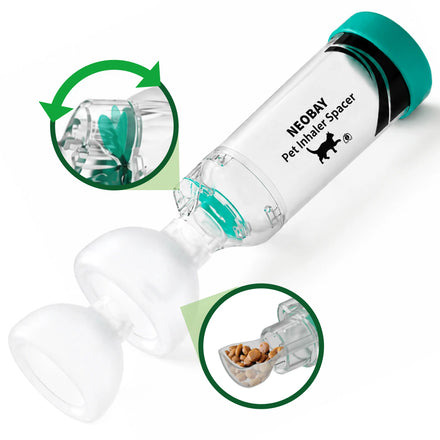
Neobay Cat Aerosol Chamber with Comfort Feeder — Green
- See each breath with the Breath Indicator
- Built-in treat holder makes mask practice easier
- Anti-static chamber helps keep medication airborne
When It's NOT Asthma: 3 Conditions That Mimic the Early Signs
Some signs point to something other than asthma. A vet rules these out — but knowing them helps you ask the right questions.
Heart disease (HCM). Hypertrophic cardiomyopathy causes rapid breathing, lethargy, and exercise intolerance — the same early signs as asthma. Unlike asthma, HCM rarely causes coughing. A vet can often distinguish the two with an exam and chest X-rays.
Chronic bronchitis. Symptoms overlap heavily with asthma: coughing, wheezing, exercise intolerance. The distinction matters because bronchitis is inflammatory but not allergic — medication approach can differ.
Upper respiratory infections (chronic, low-grade). Lingering nasal inflammation can cause subtle breathing changes and mild lethargy. The key difference: URIs typically involve nasal discharge or eye symptoms. Pure lower airway asthma usually doesn't.
Bottom line: if you're seeing any of the early signs, don't self-diagnose. Get a vet to rule out the mimics. The diagnostic process — chest X-rays, possibly a trial of bronchodilators — is straightforward.
What to Do If You Notice These Signs
Step 1: Film it. Cats are masters at acting perfectly normal at the vet's office. The coughing, the wheezing, the weird posture — it all vanishes the moment they're in a carrier. A 10-second phone video of the behavior you're seeing is often the single most useful diagnostic tool your vet will have.
Step 2: Count resting breaths. Do this three or four times over the course of a week while your cat is deeply asleep. Write down the numbers. Bring them to the appointment. See our full guide on how to monitor your cat's breathing rate at home.
Step 3: Book the vet visit. Don't wait until the signs get worse. Early asthma is manageable. Advanced asthma with airway remodeling is a lot harder to reverse. If you need to understand what the diagnostic process looks like, read how vets diagnose feline asthma.
Step 4: If it's asthma, treatment has come a long way. Inhaled steroids through a cat-specific spacer are now the gold standard — no systemic side effects, no daily pills. A device like the Neobay Cat Aerosol Chamber lets you administer medication in under a minute, with a visual flow indicator that confirms each dose. Most cats adapt within a week with the right training approach.
Frequently Asked Questions
How do I know if my cat has asthma or just hairballs?
Asthma coughs are dry — your cat hunches low, extends the neck, and nothing comes up. Hairballs end with an actual fur tube. If the coughing repeats over days or weeks with nothing produced, it's far more likely to be asthma. Film it and show your vet.
What does a cat asthma cough sound like?
Most owners describe it as a dry, wheezy hacking — like the cat is trying to cough something up but can't. Some compare it to a goose honk or a dry heave. It's distinctly different from the wet, guttural sound of bringing up a hairball.
Can a cat have asthma but act completely normal?
Yes — especially early. A cat can have occasional coughing or slightly labored breathing during sleep and otherwise eat, play, and behave normally. That's exactly why early signs get missed. Normal behavior between episodes doesn't rule out asthma.
What happens if feline asthma goes untreated?
Untreated asthma leads to airway remodeling — permanent scar tissue that narrows the breathing passages. Over time this causes more frequent and severe attacks, reduced quality of life, and in extreme cases, respiratory crisis. It also means medication becomes less effective because the structural damage is irreversible.
Should I take my cat to the vet for occasional coughing?
Yes. Any coughing more than once a week — or that follows a pattern (after play, certain times of day) — warrants a vet visit. Bring a video. The workup is typically an exam and possibly chest X-rays. Catching it early means easier treatment and better outcomes.
Can cats outgrow asthma?
No. Feline asthma is chronic and lifelong. But with early diagnosis and consistent inhaled steroids via a spacer, most cats live completely normal lives with few or no symptoms.
What to Do Next
- Count your cat's resting breathing rate tonight — it takes 15 seconds.
- If you've seen coughing, film the next episode on your phone.
- If either looks concerning, learn what the diagnostic process involves and book a vet visit.
- If asthma is diagnosed, understand how a spacer chamber works and why it's the standard of care.
Most cats with asthma live long, happy, active lives. The difference between a tough outcome and a normal life almost always comes down to how early someone noticed the signs.
Have questions? Visit our FAQ page or contact us directly.
Sources:
- Venema CM, Patterson CC. "Feline asthma: what's new and where might clinical practice be heading?" Journal of Feline Medicine and Surgery, 2010; 12(9): 681-692.
- Cornell Feline Health Center. "Feline Asthma: What You Need to Know." Cornell University College of Veterinary Medicine. https://www.vet.cornell.edu/departments-centers-and-institutes/cornell-feline-health-center/health-information/feline-health-topics/feline-asthma-what-you-need-know
- Trzil, J.E. "Feline Bronchial Disease: Acute and Long-Term Management." Veterinary Clinics of North America: Small Animal Practice, 2020.
- Cat Sleeping Respiratory Rate: The 2025 Veterinary Benchmark
Related Reading
This article is part of our Feline Asthma: The Complete Owner's Guide — covering everything from causes and symptoms to treatment and daily management.


