

Key Takeaways
- Feline asthma has no single definitive test — it's a diagnosis of exclusion, meaning other diseases must be ruled out first
- Heartworm-associated respiratory disease (HARD) is the most commonly missed mimic, producing nearly identical symptoms to asthma
- Cats with heart disease rarely cough — unlike dogs, feline heart failure presents as rapid or labored breathing, not coughing
- If your cat's "asthma" isn't responding to inhaled steroids within 2-4 weeks, something else may be going on
- A proper workup includes at minimum: thoracic radiographs, heartworm antigen + antibody testing, and often an echocardiogram
Your cat has been coughing. The vet listens, takes an X-ray, and says the words you've been dreading: "It looks like feline asthma."
You go home with an inhaler and a spacer. You do everything right. But weeks pass, and your cat isn't better. Or maybe the coughing stopped for a bit — then came back worse.
Here's what most online resources won't tell you upfront: feline asthma is a diagnosis of exclusion. Vets arrive at it by ruling everything else out — and that list is longer than most owners realize.
The conditions that mimic feline asthma can look identical: same cough, same wheeze, same X-ray patterns. Some are just as manageable. Others are emergencies with a ticking clock.
Why "Feline Asthma" Isn't Always Asthma
In human medicine, asthma has clear diagnostic criteria: spirometry, peak flow, response to bronchodilators. In cats? None of that works.
A cat can't inhale on command for a spirometer. So vets rely on history, physical exam, thoracic radiographs, and response to treatment. It's an educated judgment call — and sometimes, it's wrong.
A 2019 review in the Journal of Feline Medicine and Surgery put it bluntly: feline asthma and heartworm disease "cannot be reliably distinguished" by clinical signs alone. The same cough. The same wheeze. Even the same X-ray changes in some cases.
5 Conditions That Look Exactly Like Feline Asthma
1. Heartworm-Associated Respiratory Disease (HARD)
This is the big one. The JFMS review noted that many feline heartworm cases have historically been misdiagnosed as asthma — for years.
Unlike dogs, cats with heartworm usually carry only 2-3 adult worms. Some have zero adults — just immature worms that die in the lung arteries, triggering massive inflammation. This is called HARD (Heartworm-Associated Respiratory Disease) , and its symptoms are indistinguishable from asthma: coughing, wheezing, rapid breathing, intermittent gagging.
Standard heartworm antigen tests look for adult female worms. If your cat only has immature worms or only male worms, the test comes back negative and the vet moves on. The more reliable approach combines antigen AND antibody testing plus echocardiography.
If your cat was diagnosed with asthma based on symptoms and a negative antigen test alone, HARD hasn't been ruled out.
2. Hypertrophic Cardiomyopathy (HCM → Congestive Heart Failure)
HCM is the most common heart disease in cats. It thickens the heart muscle until the heart can't pump efficiently. Fluid backs up into the lungs — and your cat is breathing fast, struggling, maybe coughing.
But here's what most owners never hear: coughing cats are rarely cardiac. The veterinary mantra is that cats in heart failure present with tachypnea (rapid breathing) and dyspnea (labored breathing) — not the hacking cough that typifies asthma. If your cat's main symptom is fast shallow breathing at rest rather than coughing, heart failure drops down the list.
That said, the overlap is real. An echocardiogram read by a board-certified cardiologist is the gold standard for ruling out HCM.
3. Pleural Effusion
Pleural effusion means fluid accumulates between the lungs and chest wall — compressing the lungs from the outside. Causes include heart failure, cancer (lymphoma), FIP, and chylothorax.
A cat with pleural effusion breathes fast and shallow. Heart and lung sounds are muffled on exam. Chest X-rays show the fluid line. But in early stages, the signs can be subtle enough to get labeled as an "asthma flare."
Thoracic radiographs and thoracocentesis (drawing fluid with a needle) are diagnostic and often immediately therapeutic — removing the fluid lets the cat breathe again.
4. Lungworm (Aelurostrongylus abstrusus) and Other Parasites
Cats who hunt or spend time outdoors can pick up lungworm from eating snails, slugs, or prey animals carrying larvae. The worms migrate to the lungs and cause chronic coughing, wheezing, and bronchial inflammation — identical to asthma on presentation.
Diagnosis requires a Baermann fecal test (not a standard fecal float), which most clinics don't run unless specifically requested. If your cat goes outside and "asthma" treatment isn't working, lungworm belongs on the list.
5. Bacterial Pneumonia, Neoplasia, and Other Mimics
Bacterial pneumonia produces cough, fever, and lethargy. Lung tumors can cause chronic cough and X-rays that get read as "bronchial pattern consistent with asthma." Nasopharyngeal polyps, inhaled foreign bodies, and chronic bronchitis round out the conditions that wear an asthma costume.
The pattern repeats: symptoms overlap, X-rays can mislead, and without the right follow-up tests, the wrong label sticks.
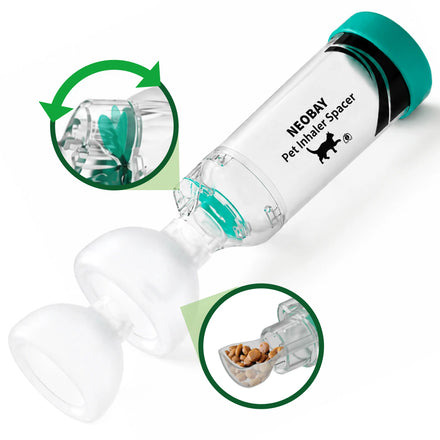
Neobay Cat Aerosol Chamber with Comfort Feeder — Green
- See each breath with the Breath Indicator
- Built-in treat holder makes mask practice easier
- Anti-static chamber helps keep medication airborne

What a Real Diagnostic Workup Actually Looks Like
If your vet suspects feline asthma, here's what a thorough workup should include:
- Thoracic radiographs (chest X-rays) — 2-3 views minimum. Look for bronchial or "donut" patterns (asthma), cardiomegaly (HCM), pleural fluid lines (effusion), or masses (neoplasia)
- Heartworm antigen + antibody test — both, not just antigen. Antigen alone misses HARD in a significant percentage of cases
- Echocardiogram (heart ultrasound) — if there's any suspicion of heart disease. Have a cardiologist read it, not a general practitioner
- Baermann fecal test — if the cat has outdoor access or a hunting history
- Complete blood count (CBC) — check for eosinophilia (high in both asthma AND parasites)
- Response to treatment trial — inhaled fluticasone + bronchodilator for 2-4 weeks, with clear benchmarks for improvement
If your cat does have true asthma, a proper inhaler spacer with a visual flow indicator takes the guesswork out of treatment. You can see the valve move with each breath — you know the dose went in. That certainty matters when you're tracking whether treatment is actually working.

7 Red Flags Your Cat's "Asthma" Diagnosis Might Be Wrong
- Zero response to inhaled steroids after 4 weeks — true feline asthma typically improves within 2-4 weeks on fluticasone
- Your cat's main symptom is fast shallow breathing at rest, not coughing — think heart, not lungs
- The diagnosis was made without thoracic radiographs — you can't diagnose asthma by stethoscope alone
- Heartworm testing was antigen-only and negative — HARD is still on the table
- Your cat has a heart murmur AND respiratory symptoms — push for an echocardiogram
- Symptoms started suddenly in an older cat with no prior history — new-onset "asthma" in a 12-year-old cat needs a broader workup
- Your cat goes outdoors and isn't on parasite prevention — lungworm and heartworm risk are real
Frequently Asked Questions
Can a cat be misdiagnosed with asthma?
Yes. Feline asthma is a diagnosis of exclusion with no single definitive test. Conditions like heartworm disease (HARD), hypertrophic cardiomyopathy, pleural effusion, and lungworm can produce identical symptoms and similar chest X-ray patterns.
How do vets actually diagnose asthma in cats?
Through a combination of history, physical exam, thoracic radiographs, bloodwork, heartworm testing, and response to treatment. There is no single "asthma test" for cats. Vets rule out other causes first, then confirm by observing improvement on inhaled corticosteroids over 2-4 weeks.
What does heart failure look like in cats vs asthma?
Cats in heart failure typically breathe fast and shallow (tachypnea/dyspnea) rather than cough. The veterinary rule is "coughing cats are not cardiac." Asthma cats hack and wheeze; heart failure cats breathe rapidly with effort, often with open mouths. Pleural effusion muffles heart and lung sounds.
My cat was diagnosed with asthma but the inhaler isn't helping. What now?
Go back to your vet and ask for a broader workup: heartworm antigen + antibody testing, echocardiogram, and a Baermann fecal test if your cat goes outdoors. True feline asthma usually responds to inhaled steroids within 2-4 weeks. No response is a red flag.
Can indoor cats get heartworm?
Yes. Heartworm is spread by mosquitoes, which get indoors. Roughly 25-30% of heartworm-positive cats are indoor-only. There is no approved adulticide treatment for cats, making monthly prevention the only option.
What to Do Next
- If your cat was diagnosed based on symptoms alone — no X-rays, no heartworm testing — schedule a follow-up and request thoracic radiographs
- If your cat is on inhaled medication and not improving after 2-4 weeks, discuss the red flags above with your vet
- If you're starting inhaled treatment, use a spacer with a visual flow indicator so you can confirm every dose is delivered
If your cat's diagnosis is confirmed as asthma, inhaled therapy with a proper spacer chamber is the gold-standard treatment. Visit our cat inhaler spacer collection or read our guide on how to administer inhaled medication stress-free.
Have questions about your cat's symptoms? Always consult your veterinarian first. For product questions, visit our FAQ page or contact us.
Sources:
- Garcia-Guasch et al. "Feline asthma and heartworm disease: Clinical features, diagnostics and therapeutics." *Journal of Feline Medicine and Surgery*, 2019.
- "Clinical Challenge: The Coughing Cat." *Clinicians Brief*, August 2022.
- Lee, J. "Coughing cats are NOT cardiac." *VETgirl Veterinary Continuing Education Blog*.
- "Does My Cat Have Heartworm Disease or a Respiratory Issue?" *Zoetis Petcare*.
- Cornell Feline Health Center. "Feline Asthma: What You Need to Know." Cornell University College of Veterinary Medicine. https://www.vet.cornell.edu/departments-centers-and-institutes/cornell-feline-health-center/health-information/feline-health-topics/feline-asthma-what-you-need-know
Related Reading
This article is part of our Feline Asthma: The Complete Owner's Guide — everything you need to know about symptoms, diagnosis, treatment, and living with a cat with asthma.


