

Key Takeaways
- Cats do not outgrow asthma. It's a chronic, lifelong inflammatory condition. The underlying airway disease never goes away — but with consistent treatment, symptoms can become minimal or absent for years.
- True remission is rare but clinical control is common. Most cats on daily inhaled steroids live normal lives without visible symptoms. The distinction matters: controlled is not cured, and stopping medication risks silent disease progression.
- The prognosis is good. Multiple veterinary studies agree: asthma is rarely fatal when properly managed. Life expectancy for a well-managed asthmatic cat is essentially normal.
- Untreated asthma gets worse. Persistent inflammation causes airway remodeling — permanent thickening and scarring of the airways that can't be reversed. This is why stopping treatment when symptoms disappear is dangerous.
- Weight, allergens, and treatment adherence are the three biggest factors that determine whether your cat stays well-controlled or has recurring flare-ups.
Your cat has been on the inhaler for six months. No coughing. No wheezing. You're starting to wonder: do we really need to keep doing this every day? Maybe they've gotten better. Maybe they've outgrown it.
This is one of the most common and dangerous assumptions cat owners make about feline asthma. The answer matters because what you do next — continue treatment or stop it — directly shapes how your cat's lungs look five years from now.

Why Cats Don't "Outgrow" Asthma
Feline asthma is fundamentally an allergic inflammatory disease. The cat's immune system overreacts to inhaled allergens — dust, pollen, mold, litter particles — by flooding the airways with inflammatory cells. This isn't something they mature out of, like a kitten outgrowing clumsiness. It's a wired-in immune response.
Think of it less like a childhood cold and more like human asthma or a peanut allergy. The predisposition doesn't disappear. What changes is how well it's managed.
The airway inflammation itself follows a dangerous pattern if left untreated. Acute inflammation — the kind that causes coughing and wheezing during a flare — is visible and alarming. But chronic low-grade inflammation, which causes no obvious symptoms, slowly remodels the airway walls. Over months and years, the bronchi thicken and lose elasticity. This process, called airway remodeling, is irreversible. Once the structural changes are in place, no amount of medication can undo them.
This is the core reason vets say asthma is "lifelong." It's not that symptoms can't be controlled. It's that the disease keeps progressing when you stop treatment, even when your cat looks fine.
What "Remission" Actually Means
You'll sometimes hear vets or articles mention "remission" in feline asthma. The term is misleading if you're used to how it's used in cancer — where remission can mean the disease is undetectable.
In feline asthma, remission means clinical remission: no visible symptoms. The cat isn't coughing. Breathing rate is normal. The owner sees a healthy cat. But bronchoalveolar lavage studies — where researchers actually sample the fluid from deep in the lungs — consistently show that inflammatory cells remain present even during symptom-free periods.
A small number of cats do achieve something closer to true remission through aggressive allergen avoidance. If a cat's asthma is triggered by a specific allergen — say, a particular type of litter or cigarette smoke — and that trigger is permanently removed, the inflammatory cycle can break. One veterinary thesis noted cases where restricting a cat's access to an owner's bedroom (due to human dander allergy) led to sustained symptom remission. But these cases are the exception, and they only apply when the trigger is both identifiable and removable.
For most cats, the realistic goal is sustained clinical control: no symptoms with consistent daily medication, normal activity levels, and a respiratory rate under 30 at rest. That's a win. That's what treatment aims for.
Long-Term Outlook: What the Data Says
The prognosis for feline asthma is better than most owners assume at diagnosis. A review in the Journal of Feline Medicine and Surgery characterized it bluntly: "morbidity is relatively high, but mortality is low." Translation: asthma causes a lot of coughing and vet visits, but it rarely kills cats when managed.
Several factors determine where your cat lands on the spectrum:
Severity at diagnosis. Cats who first present with a severe attack — open-mouth breathing, blue gums — have a more guarded outlook than those caught early with occasional coughing. Early intervention before airway remodeling sets in makes a measurable difference.
Treatment consistency. The single biggest variable under your control. Cats who receive inhaled fluticasone twice daily, every day, without gaps, have dramatically fewer emergency visits than cats on inconsistent schedules. The feline asthma community's consensus — backed by years of collective owner experience — is that missed doses are the #1 cause of breakthrough flares.
Weight. Obesity mechanically restricts breathing and promotes systemic inflammation. Overweight asthmatic cats have worse outcomes across every study that's looked at this. Weight management isn't a nice-to-have; it's part of asthma treatment.
Allergen control. HEPA filtration, dust-free litter, no smoking or vaping indoors, hard flooring where possible. These environmental changes reduce the inflammatory load on the lungs and can mean the difference between needing maximum-dose fluticasone and staying stable on a moderate dose.

What Happens If You Stop Treatment
The timeline is predictable:
Weeks 1-4 after stopping: most cats look fine. The residual anti-inflammatory effect of fluticasone takes time to fully clear. Owners often feel validated — "see, they didn't need it."
Weeks 4-12: low-grade inflammation rebuilds. There are no visible symptoms yet, but eosinophils are accumulating in the airways. If you did a BAL at this point, you'd see inflammation returning.
Months 3-6: symptoms return. Often more severe than before, because the airways have had months of unchecked inflammation. Some cats who previously only coughed now present with full respiratory distress.
Years of intermittent treatment: airway remodeling compounds. Each untreated inflammatory cycle adds another layer of scarring. Cats who've gone through multiple stop-start cycles often end up needing higher doses and having poorer responses to medication than cats maintained consistently.
None of this is meant to scare. It's meant to explain why vets insist on daily treatment even when the cat looks perfect. The medication isn't just treating symptoms — it's preventing cumulative, irreversible lung damage.
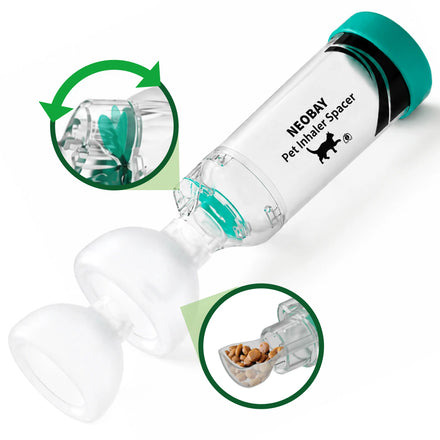
Neobay Cat Aerosol Chamber with Comfort Feeder — Green
- See each breath with the Breath Indicator
- Built-in treat holder makes mask practice easier
- Anti-static chamber helps keep medication airborne
Frequently Asked Questions
If my cat hasn't coughed in a year, can I reduce their fluticasone dose?
Maybe — but only with your vet's guidance. Some cats stabilize at a lower maintenance dose after 6-12 months of good control. The safe way to find out is: reduce the dose, then monitor breathing rate weekly for 4-6 weeks. If the rate stays stable and no symptoms return, the lower dose may be sufficient. Never reduce without tracking objective data.
Are some cats more likely to have severe asthma than others?
Siamese and Oriental breeds appear overrepresented in asthma studies, suggesting a genetic component. Young to middle-aged cats (2-8 years) are most commonly diagnosed. But severity varies more by individual than by breed — a domestic shorthair can have severe asthma and a Siamese can have mild, intermittent symptoms.
Will my cat's life be shorter because of asthma?
For a well-managed cat on consistent inhaled therapy, there's no evidence of shortened lifespan. The cats who die from asthma are almost always those who experience an unmanaged severe acute attack or whose owners couldn't afford ongoing treatment. Daily inhaled fluticasone fundamentally changes the trajectory.
Can kittens have asthma, or does it only develop in adults?
Asthma can develop at any age, but it's most commonly diagnosed between ages 2 and 8. Kittens under 1 year with coughing or wheezing are more likely to have respiratory infections or congenital issues than true asthma, though early-onset asthma does occur. A kitten with persistent respiratory symptoms needs a full workup — don't assume it's "just a cold."
Does spaying or neutering affect asthma?
No direct effect. However, neutered cats are at higher risk of obesity, which worsens asthma outcomes. Weight management after neutering is particularly important for asthmatic cats.
What to Do Next
- If your cat is doing well on treatment: keep going. Good control is evidence the treatment is working, not evidence you can stop. Track breathing rate monthly to confirm stability.
- If your cat has occasional symptoms despite treatment: talk to your vet about dose adjustment. Most cats need 220mcg (250mcg) fluticasone twice daily. A lower dose that leaves breakthrough symptoms isn't adequate.
- If you're struggling with medication cost: international pharmacies offer significant savings on generic fluticasone. The spacer device is a one-time purchase — Neobay's chamber ($39.99) lasts 12-18 months with daily use.
Asthma management is a marathon, not a sprint. The goal isn't to cure the disease — it's to make it irrelevant to your cat's daily life. Most cats get there. Yours can too.
Have questions about your cat's specific situation? Visit our FAQ page or contact us.
Related Reading
This article is part of our Feline Asthma: The Complete Owner's Guide — everything you need to understand your cat's condition, from symptoms to treatment options.
Sources:
- *Journal of Feline Medicine and Surgery*. "Feline asthma and heartworm disease: Clinical features, diagnostics and therapeutics." 2019.
- MedVet. "Asthma in Cats: Signs, Causes, Treatment & Long-Term Management."
- Catster. "Can Cats Have Asthma? Vet-Approved Causes, Signs, & Treatment Tips."
- UGent thesis. "Feline asthma: A literature review." Faculty of Veterinary Medicine, 2016.


